The Missing Piece in Your Growth Strategy: Trusted Advisors
For professional services firms, expertise alone is no longer enough to drive sustainable growth. If your growth strategy doesn’t intentionally develop trusted advisors across your firm, you’re likely missing opportunities to win new business, deepen client relationships, and expand existing accounts. While your team may have exceptional technical knowledge, clients increasingly value professionals who anticipate challenges, provide strategic guidance, and proactively connect them with solutions. When those relationships aren’t built, someone else often steps in to fill the trusted advisor role.
The firms that consistently grow understand that becoming a trusted advisor isn’t just a client service philosophy—it’s one of the most effective business development strategies available. Professionals who earn trust create stronger client loyalty, uncover new opportunities, and become indispensable partners rather than interchangeable service providers.
So, what does it take to become a trusted advisor? In this article, you’ll learn the foundation of the trusted advisor approach, the three phases of trusted advisor relationships, and nine essential traits that help professionals strengthen client relationships and accelerate long-term growth.
How Do You Build Trusted Advisors Across Your Firm?
The most obvious foundation of being a trusted advisor in a professional services firm is that your clients and prospects trust you to give them solid advice and ideas. There are two other foundations of being a trusted advisor that aren’t talked about as much: you as the advisor need strong trust in your client.
This is the concept of mutual lifetime value that is built over time. In the early stages of a trusted advisor relationship, you are in the trust-building phase. The conversations you lead and the advice you give helps them to trust you. The client being engaged in those conversations and implementing that advice helps you to trust them and creating that mutual value.
The last foundation of being a trusted advisor may be the most challenging, and that’s to build trust in yourself. Your honoring commitments to yourself, your continued engagement in building both your practical knowledge and emotional intelligence is what will help you to trust yourself. You’ll have confidence and gravitas that clients will value. Without filling your own trust bank, it’s challenging to fill the trust bank of others.
Three Relationship Phases of the Trusted Advisor in Professional Services
As you build relationships with prospects, the greater community, and your client base there are typically three phases a relationship can pass through. By contributing to Outcomes (horizontal axis) important to that individual, you’ll exponentially improve the Relationship Value (vertical axis).
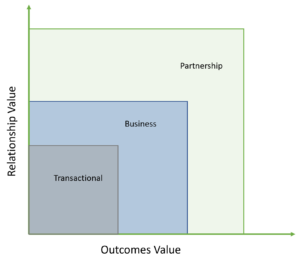
Amy Franko’s Three Relationship Phases of the Trusted Advisor
1. Transactional Relationship.
These relationships can take one of two forms. It might be that the relationship is early stage and needs time to grow. The form is that it simply stays a transactional relationship because there may be value differences in what the client values versus what you can provide. In that case, you’ll likely not get to a trusted advisor relationship.
2. Business Relationship.
This is a strong middle ground, and your business relationships are those with the greatest potential to turn into partnerships. As you’re evaluating which relationships you can move along further, these are the relationships to choose from. Some relationships will remain in that tier. You’ll have some success as a trusted advisor, but what you’re really looking to earn is that next level.
3. Partnership Relationship.
These are the relationships with deep trust, and usually a long-term engagement or series of opportunities. Even when they come to completion, you’re still one each other’s networks contributing to outcomes and relationship value. These are also your centers of influence or strategic partnerships; there may not always be a revenue-based opportunity but you’re creating that partnership through idea generation, introductions, or advice.
Growth Strategy: Trusted Advisor Traits for Partnership Relationships with Your Clients
- This is your ability to help clients create a vision for their next evolution or future results.
- Navigating toward future while maintaining context from the past. Think of vision as the end desired state, and navigation as walking the path to get to that destination. There are times when that trust building includes an understanding of past context, so the past doesn’t become an impediment to the future.
- Doesn’t need to be in the spotlight. Trusted advisors don’t need the spotlight for themselves, they allow their clients to shine. However, this doesn’t mean that a trusted advisor isn’t comfortable in the spotlight when needed, especially in executive-level conversations.
- Trend spotting, able to connect the dots of various ideas. Trusted advisors pay attention to the global, industry, marketplace, and cultural trends that could create opportunities or risks for their clients. They have a curiosity about these issues, are willing to research them, and draw their own conclusions.
- Executive presence. Trusted advisors practice the four pillars of executive presence: business acumen, communication skills across a variety of styles and platforms, personal vitality, and overall impact.
- Emotional intelligence. Perhaps more important that your lane of expertise, your EQ is that ability to “read the room,” understand body language, and understand motivations behind decisions. It’s the practice of empathy and compassion, along with understanding how your decisions and behaviors affect other people and outcomes.
- Comfort and confidence with executive level individuals. Trusted advisors have a calm demeanor and confidence about them in virtually any situation, and they have a gravitas about them when it comes to working with influential leaders and executives.
- There’s a balance here that trusted advisors strike. They are open to conversation and other ideas, but also know when a decisiveness is required to help a client navigate their path.
- Holistic approach to the entire business and person, not just your area of expertise. Trusted advisors are comfortable being “our of their lane” in that they view the business landscape and the people they advise in a holistic way. Trusted advisors who take a broad approach to a client’s entire business and their personal goals in a partnership-level relationship will make the most significant impact.
Every Professional Services Firm Needs a Growth Strategy Built Around Trusted Advisors
Amy Franko helps professional services firms build growth strategies that create lasting client relationships, strengthen business development capabilities, and drive sustainable revenue growth. Through growth strategy consulting, leadership development, and sales transformation, she equips firms to become more client-centric, more effective, and better positioned to win. Ready to elevate your growth strategy? Contact Amy to schedule a conversation.
Frequently Asked Questions
Trusted advisors are a competitive advantage because they strengthen client relationships, uncover new opportunities, and increase client retention. Rather than focusing only on delivering technical expertise, trusted advisors proactively identify business challenges, provide strategic guidance, and connect clients with solutions across the firm. Organizations that intentionally develop trusted advisors as part of their growth strategy are better positioned to win new business and expand existing accounts.
Developing trusted advisors requires more than technical training. Firms should invest in business development skills, executive communication, emotional intelligence, industry insight, and relationship-building capabilities. A successful growth strategy creates consistent opportunities for professionals to build trust, anticipate client needs, and become valued strategic partners.
Trusted advisor relationships typically evolve through three phases: transactional, business, and partnership. While transactional relationships focus on delivering services, partnership relationships are built on mutual trust, strategic collaboration, and long-term value creation. The strongest firms intentionally help clients progress toward partnership-level relationships.
Technical expertise earns credibility, but it rarely creates long-term differentiation on its own. Clients increasingly seek advisors who understand their business, anticipate future challenges, and offer strategic perspectives beyond a specific area of expertise. Without these capabilities, firms risk losing opportunities to competitors who build stronger advisory relationships.
Trusted advisors combine business acumen with strong relationship skills. They demonstrate executive presence, emotional intelligence, strategic thinking, curiosity about industry trends, confidence with senior leaders, and a holistic understanding of their clients' business goals. These qualities enable them to create lasting partnerships that contribute to sustainable growth.
Professional services firms partner with Amy Franko to build growth strategies that strengthen business development, deepen client relationships, and create more trusted advisors across the organization. As a growth strategist, keynote speaker, and advisor, Amy helps firms modernize their approach to winning and growing business by developing the skills, leadership, and client-centric behaviors that drive sustainable growth. She is the author of the Amazon bestselling book The Modern Seller and has been recognized by LinkedIn as a Top Sales Voice for her expertise in sales strategy, leadership, and business growth.
 Our Strategic Selling signature sales training program is now available online. This online sales learning program is ideal for professional services and B2B sales. Get started with 2 free lessons.