Growth Strategy: How do growth leaders make better growth decisions using data?
Last updated on June 22nd, 2026 |

Chief Growth Officers and Sales leaders: how can you make better growth decisions using data? This article introduces a strategy using a Balanced Data Framework to help cut through the noise. Learn how to balance data with context, avoid overload, and make confident, impact-driven decisions.
********
Business leaders are surrounded by data. Revenue dashboards, customer insights, market trends, pipeline metrics, profitability reports, AI-generated analytics, and economic indicators all compete for attention. Yet more data doesn’t automatically lead to better decisions.
The challenge for CEOs, Chief Growth Officers, and sales leaders is knowing which signals matter, how to apply context, and when to act. The Balanced Data Framework helps leaders cut through the noise, evaluate opportunities, and make confident growth decisions.
As it relates to data, I have a colleague who is a customer experience expert. She would talk about “using both the head and heart” when it comes to running an organization and finding balance with data. That includes interacting with clients, working with business partners, living in the greater community, or guiding internal teams.
With so many sources of data, how do we use it smartly to guide our business and growth decisions? How do we keep from being overrun with data and using it as a crutch? How do we figure out the true story that data is telling us? How do we keep from passing over or hiding behind data critical to our decisions?
This article shares Amy Franko’s Balanced Data Framework strategy. It can be used by CEOs, Chief Growth Officers, sales leaders, or sales professionals to leverage data and other inputs to make confident decisions in any scenario.
Take your sales strategy to the next level with Amy Franko’s Sales Strategy Index.
What Questions Should Leaders Ask Before Making Data-driven Growth Decisions?
How well do you use data in your decision-making? That might not be a question you have ever pondered, but it’s an important one to consider. The smart balance of data is to know and use your sources of reliable data, but also to approach it with a healthy dose of skepticism and a willingness to question.
Below are a few strategic questions to consider:
- How have we historically used our data?
- What is the level of “data discipline” in our teams? In other words, how often are they accessing their own data in decision making, and are they taking a self-leadership role in using data? Are they accountable to their data?
- What are the common scenarios where data either helps or hinders our decision-making?
- Where do we have an over-reliance on data versus the experience and expertise of our teams?
- How strong is our team at applying context to the data? In other words, do we have the accurate story of what that data is telling us?
- How do we account for using data in our strategy?
How to Use Amy Franko’s Balanced Data Framework for Any Business Growth Decision
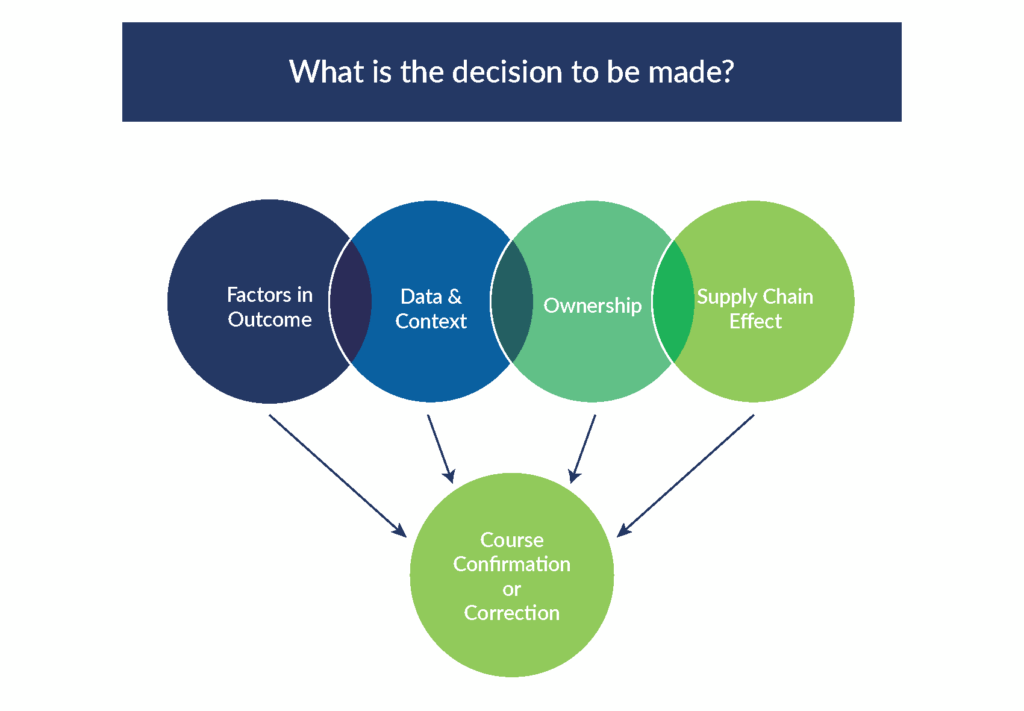
The figure above is Amy Franko’s Balanced Data Framework that you can use to assess any sales decision or other strategic decision in your organization.
1. What is the key decision to be made? Why is it important to us right now? In a sentence or two, what is the decision? Why does it matter right now? This might seem simple on the surface, but many times I’ve experienced clients adding multiple decision points within a scenario, or not being able to articulate its importance. This 2-part question is designed to help you in the most direct and simplest way to define the decision and its importance. If there are other sub-decisions involved, this is the opportunity to either remove them from the current scenario or to keep them documented as contingencies.
2. What are the Success and Failure Factors? Once you’re clear on the decision to be made and its importance, the next segue is to define the desired outcome. What will indicate success? What will indicate failure? What are the timeframes for accomplishment and evaluation?
3. What data do we have? Your decision data may come from a variety of sources, both internal and external. It may originate with systems or people. Your data is the “head” part of the “head and the heart” I referred to earlier. The figures, percentages, and statistics. What you’re wanting to uncover is what data is available to you, what is missing, and to what extent do you trust the data.
4. What are the contextual factors outside of the data? The contextual factors are as important as the data itself. This is the “heart” part of the equation. Contextual factors often come from expertise and experience, whether that be your own, an outside strategic consultant, or your team. They are the stories that you need to listen to in order to best interpret the data in front of you. Ignoring contextual factors and only relying on the figures can send you in the wrong direction.
5. Who has ownership of this decision? With many initiatives and decisions having committees in the mix, it’s important to outline the ultimate ownership of the decision you’re looking to make. Who will decide to move forward or not; who will decide on the course corrections needed? Who is willing to publicly take that ownership?
6. What is the Supply Chain Effect? No organization lives in a vacuum. When a decision is made there will be impacts across the ecosystem. Some of these impacts are intended, and some are unintended consequences. I called this the Supply Chain Effect and write about it within my Amazon best-selling book, The Modern Seller. Modern sellers take time to understand all the possible effects of a decision. Whether that is a supply chain of relationships, or a supply chain of goods and services, how will it be impacted by the decision path you choose?
7. Course confirmation or correction. The very essence of a decision is to choose one path over another and commit to it. Imperfect action is always better than perfect inaction. There’s always the option to course correct. You’ll often find that parts of the decision were spot on, and parts of the decision may need to be adjusted. In my figure above, each element of the framework can lead back to course confirmation or correction at any point. When you have strong ownership over the course of action, that ownership can also help with decisive course correction.
A next step is to apply the Balanced Data Framework to a key leadership decision. It will help you move through your decision process with the right balance of data and context.
Make smarter sales decisions by balancing data with real-world insight.
Whether it’s a framework like the one above, or significantly improving other elements of your growth strategy, Amy Franko can help. If you’d like to leverage more strategies like this one to grow your business, let’s talk. Contact Amy to schedule a conversation.
Frequently Asked Questions
The framework provides a structured approach to balance data with real-world context, helping your team avoid data overload and focus on what matters for confident, effective sales strategy decisions.
Prioritize reliable data sources like CRM metrics, deal velocity, and revenue trends. The framework also emphasizes balancing this data with contextual insights from team experience and market trends for a well-rounded decision.
It encourages leaders to use data thoughtfully alongside “heart” factors—like customer relationships and team expertise—so decisions are not only data-driven but also aligned with on-the-ground realities.
 Our Strategic Selling signature sales training program is now available online. This online sales learning program is ideal for professional services and B2B sales. Get started with 2 free lessons.